
8 Best Working Capital Options: Seasonal Businesses Canada

TL;DR
Seasonal businesses in Canada face a core problem: expenses stay constant while revenue disappears for months at a time. The best options for seasonal businesses needing working capital in Canada include bank lines of credit, the government-backed CSBFP line of credit, invoice factoring, asset-based lending, BDC working capital loans, equipment leasing with skip payments, multi-product structuring through a finance intermediary, and (as a last resort) merchant cash advances. Revolving structures that let you draw and repay in rhythm with your cash flow cycle are almost always safer than fixed-payment products.
Why Seasonal Cash Flow Is a Structural Problem
Nearly 50% of small business owners rank cash flow as their top financial challenge. For seasonal businesses, that challenge is amplified. A landscaping company earns nothing from November through March, but still pays rent, insurance, vehicle loans, and often a skeleton crew. A tourism operator on Vancouver Island generates 70% of annual revenue in four months. A construction firm waits 60 to 90 days for payment on contracts completed during the building season.
Tourism alone supports approximately 10% of Canada’s national labor force, and that’s just one seasonal sector. Add construction, agriculture, landscaping, event management, and seasonal retail, and you’re looking at a massive share of the Canadian SME economy dealing with the same structural mismatch: fixed costs, variable revenue.
The good news is that Canadian lenders, government programs, and alternative finance providers have built products specifically designed for this reality. The key is knowing which ones fit your situation, and which ones could make things worse.
If you’re weighing your options and want help narrowing the field, submit a loan enquiry to start a conversation about what fits your cash flow cycle.
The Revolving vs. Fixed Rule: Read This First
Before comparing individual products, understand the single most important structural question for any seasonal business seeking capital: Is the repayment revolving or fixed?
Revolving facilities (lines of credit, factoring, asset-based lending) let you draw funds when you need them and pay them down when cash is flowing. You pay interest only on what you use. During your off-season, you can sit at a zero balance and owe nothing.
Fixed-payment products (term loans, merchant cash advances) collect the same amount regardless of whether your revenue has dropped to zero. A fixed daily or weekly withdrawal that runs into your slow months can drain your operating account when you can least afford it.
This distinction should guide every financing decision a seasonal business makes. The options below are ordered roughly from safest seasonal fit to most dangerous.
At-a-Glance Comparison Table
| Option | Typical Cost (2026) | Speed to Fund | Min. History | Best For | Seasonal Fit |
|---|---|---|---|---|---|
| Bank Line of Credit | Prime + 1.5–3.5% | 2–6 weeks | 2+ years | Strong-credit established businesses | ★★★★★ |
| CSBFP Line of Credit | Capped at prime + 5% | 2–6 weeks | New businesses OK | Sub-$10M revenue businesses | ★★★★★ |
| Invoice Factoring | 1–3% per invoice/30 days | 1–5 days setup | Minimal | B2B with slow-paying customers | ★★★★ |
| Asset-Based Lending | 8–15% annually | 2–4 weeks | 12+ months | Asset-rich manufacturers/distributors | ★★★★★ |
| BDC Working Capital Loan | 7.5–11.5% | 3–8 weeks | 12+ months | Bank-declined established businesses | ★★★★ |
| Equipment Leasing | Varies by credit/asset | 24 hrs–2 weeks | Startups possible | Equipment-heavy seasonal industries | ★★★★ |
| Multi-Product Structuring | Blended across facilities | Varies | Varies | Complex needs across asset types | ★★★★★ |
| Merchant Cash Advance | Factor rate 1.1–1.5x | 1–3 days | 6+ months | Emergency only, B2C card-heavy | ★★ |
Now let’s break down each option with honest costs, seasonal-specific benefits, and trade-offs.
1. Business Line of Credit (Bank or Credit Union)
Best for: Established seasonal businesses with 2+ years of history, solid financials, and good credit.
A business line of credit is the gold standard for seasonal working capital. You draw what you need during your ramp-up period, pay it down as revenue flows in, and owe nothing during your quiet months.
Cost
With the Canadian prime rate sitting at 4.45% as of mid-2026, secured business lines typically run prime + 1% to prime + 4% (5.45% to 8.45%). Unsecured lines range from prime + 3% to prime + 7% or higher. You only pay interest on the outstanding balance, which makes this by far the cheapest seasonal option when used correctly.
One practitioner example illustrates the power of this structure: a restaurant owner draws $40,000 in April to prepare for patio season, pays the balance down through summer earnings, and pays zero interest from November through March when the balance sits at zero.
For a deeper look at how credit lines create financial flexibility, read about unlocking flexibility with a bank line.
Trade-offs
- Banks typically require a debt service coverage ratio (DSCR) of 1.25x or higher, full financial documentation, and sometimes personal guarantees.
- Approval timelines run two to six weeks.
- Annual reviews can result in limit reductions if your off-season financials show losses, which is inherently unfair to seasonal businesses but common.
- Practitioners on Reddit and finance forums consistently note that bank LOC applications for seasonal businesses get flagged during underwriting precisely because the off-season months look weak on paper.
Who should skip this
New businesses, companies with bruised credit, or anyone who needs capital in under two weeks.
2. CSBFP Line of Credit (Government-Backed)
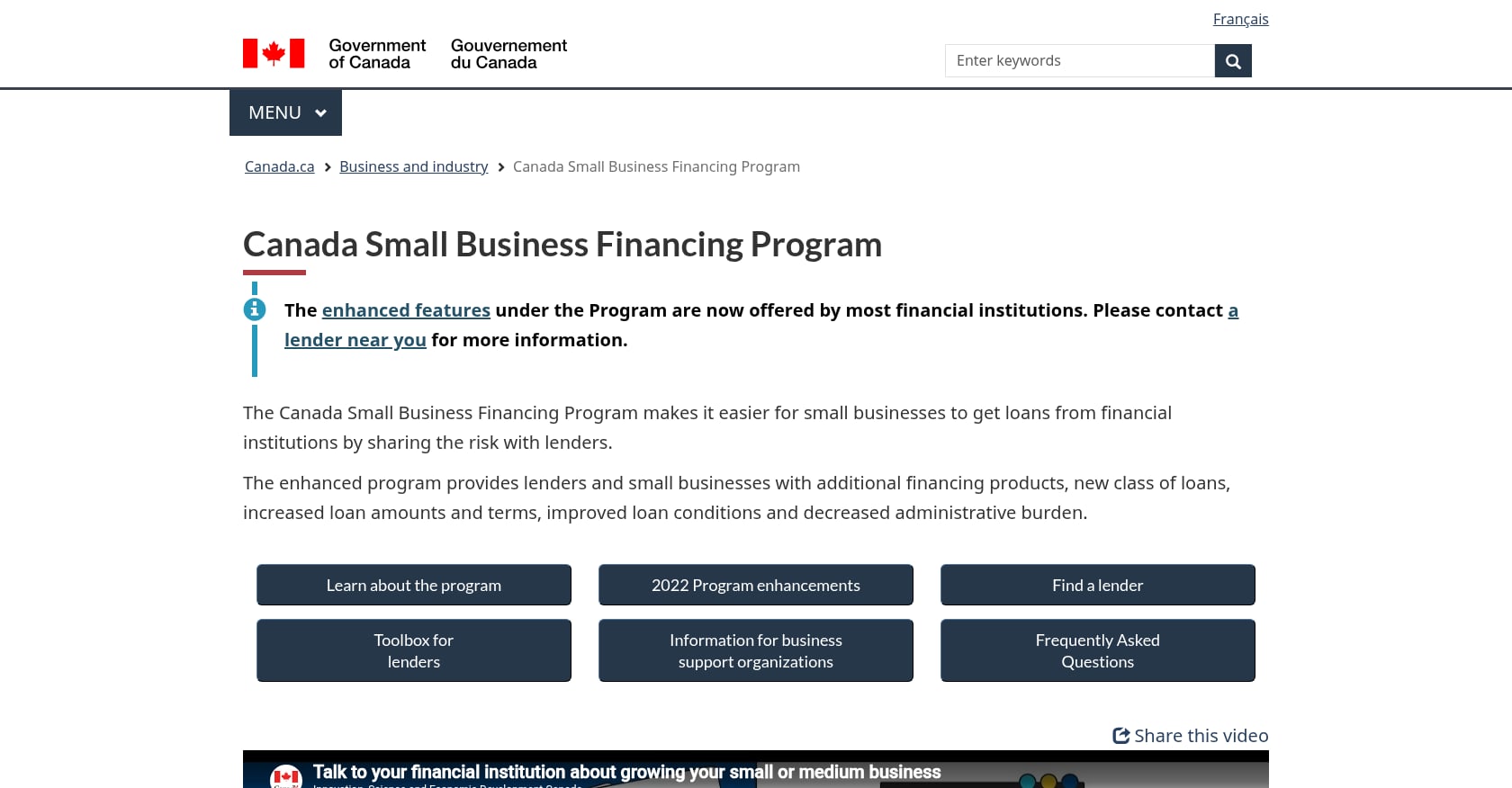
Best for: Newer seasonal businesses (under $10M revenue) that can’t yet qualify for a standard bank line of credit.
The Canada Small Business Financing Program is one of the most underutilized tools available to seasonal Canadian businesses. Over the past decade, small businesses have received over 53,000 CSBFP loans totalling $10 billion, yet many owners have never heard of it.
How it works
The federal government covers 85% of eligible losses on defaulted CSBFP loans, which makes banks and credit unions far more willing to approve applications they’d otherwise decline. The CSBFP line of credit allows up to $150,000 for working capital, separate from the $1,000,000 term loan maximum.
Cost
The CSBFP LOC is capped at prime + 5% (currently 9.45%). There’s also a 2% registration fee payable to the Government of Canada. That’s more expensive than a standard bank LOC, but significantly cheaper than most alternative lenders.
The seasonal detail most people miss
The official CSBFP guidelines explicitly state that payments may be adapted to a borrower’s needs, including blended, seasonal, or escalating structures. This means a landscaping company could structure larger payments from May through October and minimal payments over winter. No other government program offers this kind of seasonal flexibility on a working capital line.
If your business is newer and you’re wondering how to improve your odds, see these tips for startup financing approval.
Trade-offs
- Personal guarantees and business asset security are required.
- Your business must have annual gross revenue under $10 million.
- Not available to farming businesses.
- Branch staff won’t always volunteer CSBFP options. You often need to ask for it by name.
Practitioner perspective
Finance professionals consistently advise that the government guarantee makes lenders more willing to approve files they’d otherwise decline. The specific advice: walk into your bank and ask for a “CSBFP line of credit” by name, because the product won’t appear on most bank websites as a standalone offering.
3. Invoice Factoring / Accounts Receivable Finance
Best for: B2B seasonal businesses with slow-paying customers on 30, 60, or 90-day terms (construction, staffing, manufacturing, wholesale).
Invoice factoring solves a specific version of the seasonal cash flow problem: you’ve done the work, you’ve invoiced for it, but you won’t see money for weeks or months. Meanwhile, payroll is due Friday.
How it works
You sell your unpaid invoices to a factoring company at a discount and receive an advance (typically up to 90% of face value) within days. When your customer pays, the factor remits the remaining balance minus their fee.
Cost
Factoring fees typically run 1% to 3% per invoice per 30-day period. The longer your customer takes to pay, the more it costs. This makes factoring best suited for situations where receivable turnover is predictable.
Why it fits seasonal businesses
Factoring naturally scales with your revenue. During peak season, you factor more invoices and access more capital. During quiet months, there’s nothing to factor and no cost to carry. Approval criteria emphasize your customer’s creditworthiness rather than your own balance sheet, which helps seasonal businesses whose financials may look thin during off-periods.
For businesses with consistent invoicing cycles, setting up a revolving invoice finance facility can create predictable cash flow throughout the busy season.
Trade-offs
- Only works if you have B2B invoices. Retail, hospitality, and other B2C businesses can’t use this.
- The factoring company may notify your customers about the arrangement, which some business owners find uncomfortable.
- When customers take longer than expected to pay, costs increase.
- Not all factors understand seasonal industries, so choose one with sector experience.
To understand when this option beats a credit line, read about when factoring beats a bank line.
4. Asset-Based Lending (ABL)
Best for: Manufacturers, distributors, and wholesalers with meaningful receivables and/or inventory that fluctuate with the seasons.
Asset-based lending is the heavy-duty version of receivables financing. Instead of factoring individual invoices, an ABL facility provides a revolving credit line secured by your full pool of receivables, inventory, and sometimes equipment.
How it works
The lender establishes a borrowing base, typically advancing up to 90% on eligible receivables and 30% to 80% on inventory. As your assets grow during peak season, your available credit grows with them. As you wind down, the facility contracts.
Cost
ABL rates range from roughly 8% to 15% annually. Transactions typically start around $250,000 and scale into the tens of millions, so this isn’t a micro-business solution.
Seasonal advantage
This is one of the best options for seasonal businesses needing working capital in Canada that have significant asset fluctuations. A Toronto-based metal fabrication company, for example, faced seasonal cash flow gaps that prevented purchasing raw materials for spring construction contracts worth $2.8 million. Traditional banks declined financing due to previous late payments. An ABL facility provided a $650,000 credit line secured by equipment and inventory at a 75% loan-to-value ratio.
For a more detailed explanation of how ABL works across Canadian industries, check out what asset-based lending is and who can use it.
Trade-offs
- Requires regular (often monthly) reporting of receivables aging, inventory levels, and borrowing base certificates. This is administrative overhead that smaller businesses may find burdensome.
- Specialized ABL lenders build deep expertise in specific sectors. A generalist lender won’t structure this well for a seasonal business.
- Minimum facility sizes typically rule out businesses under $250,000 in eligible assets.
5. BDC Working Capital Loan
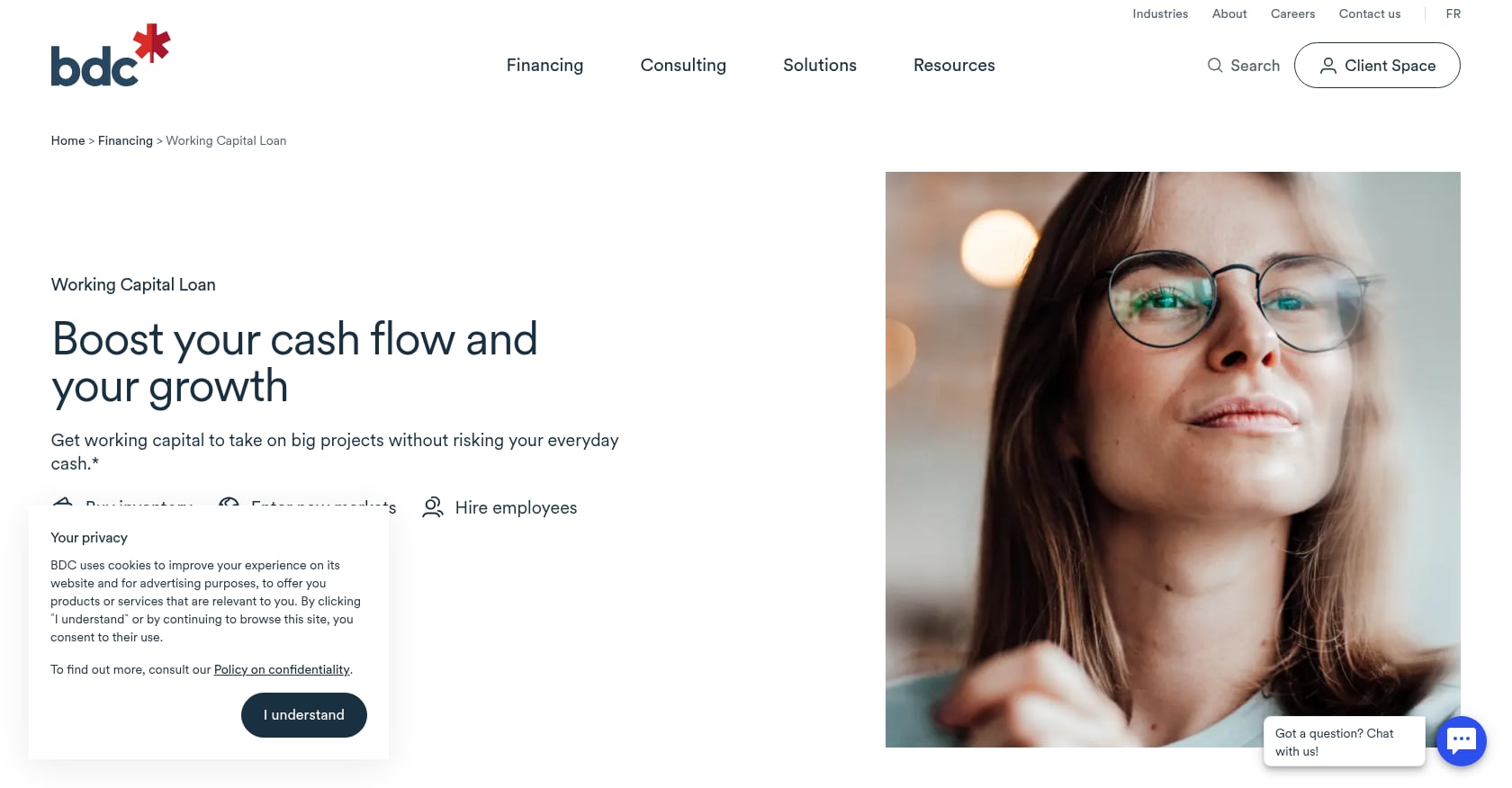
Best for: Established businesses (12+ months of revenue) that have been declined by a bank but need a structured term product with seasonal payment flexibility.
The Business Development Bank of Canada exists specifically to serve businesses that conventional banks won’t. BDC deployed $11.5 billion to 107,345 entrepreneurs in fiscal 2025, and a significant portion of that capital went to businesses with non-traditional cash flow profiles.
Cost
BDC rates currently sit in the 7.5% to 11.5% range, depending on the product and risk profile. That’s higher than a bank LOC but far cheaper than alternative lenders or MCAs.
Seasonal features
BDC explicitly offers what it calls a “match payments to your cash flow cycle” approach. Working capital loans offer preferred terms on amounts above $350,000, with up to eight years to repay and the ability to postpone principal payments for up to 24 months. BDC considers management expertise and project potential rather than relying solely on banking ratios, which matters for seasonal businesses whose numbers look volatile by nature.
Trade-offs
- Higher rates than the Big Five banks.
- Requires 12+ months of revenue history and a reasonable credit track record.
- Decision timelines can be lengthy (three to eight weeks).
- BDC products are term loans, not revolving facilities, so you’re carrying a balance year-round even if you only needed the capital for six months.
6. Equipment Leasing with Seasonal Payment Structures
Best for: Construction, landscaping, tourism, and agriculture businesses with significant equipment needs and pronounced seasonal revenue swings.
Equipment leasing doesn’t directly solve working capital shortages, but it indirectly frees up working capital by keeping large equipment purchases off your cash reserves.
How it works
Instead of paying $150,000 upfront for a piece of heavy equipment (plus HST/GST), you lease it with up to 100% financing and spread the sales tax over the term. The equipment serves as its own collateral, so approval is often faster and more flexible than unsecured products.
Seasonal payment structures
Canadian equipment lessors commonly offer skip payments, seasonal payments, semi-annual, and annual structures with terms from 12 to 84 months. A landscaping company, for example, could structure zero payments from December through March and higher payments during the earning season. Equipment leases in Canada can also be up to 100% tax-deductible, depending on how the lease is structured.
For a breakdown of lease types, read about finance lease vs. operating lease differences in Canada.
Trade-offs
- Only covers equipment. It won’t solve payroll gaps, rent, or other operating expenses.
- Leasing is independent of long-term or working capital debt. It frees up cash flow but isn’t working capital itself.
- End-of-lease obligations (buyout, return, or renewal) need to be planned for.
7. Multi-Product Structuring
Best for: Complex seasonal businesses with multiple asset types and funding needs that no single product can solve.
Why single products fall short
A construction firm might need a line of credit for payroll during ramp-up, equipment leasing for new machinery, and invoice factoring to bridge the gap between project completion and payment. No single product covers all three needs. Trying to force everything through one facility means either borrowing too much (expensive) or not enough (constrained).
The multi-product approach combines two or three facilities, each optimized for a specific purpose. A line of credit handles operating costs. Factoring or ABL accelerates receivables. Equipment leasing keeps capital expenditures off the balance sheet. Each facility scales with its own trigger (season, invoices, equipment deployment), creating a structure that breathes with the business cycle.
Many businesses maintain both a line of credit for flexibility and a CSBFP term loan for capital investments. Others combine factoring with purchase order finance and equipment leasing. The combinations are driven by your specific assets, customers, and seasonal pattern.
This kind of structuring requires an intermediary who understands multiple lender products and can coordinate across facilities. It’s not something most business owners can efficiently assemble on their own.
Speak with an advisor about how to structure multiple facilities for your seasonal business.
Trade-offs
- More complex to manage than a single facility.
- Requires clear documentation and coordination between lenders.
- Best suited for businesses with enough scale to justify multiple relationships.
8. Merchant Cash Advance (MCA), With Serious Caution
Best for: Absolute last resort for B2C businesses with high card transaction volume (retail, hospitality) when no other option is available.
Merchant cash advances are easy to get and expensive to carry. For seasonal businesses, they carry a specific danger that most articles fail to mention.
How it works
An MCA provider advances a lump sum in exchange for a percentage of your future card sales. Publicly reported factor rates typically fall between 1.1 and 1.5, meaning you repay 110% to 150% of the amount borrowed. Advances range from $5,000 to $500,000, with approval based primarily on sales volume rather than credit score.
The seasonal timing trap
An MCA repaid through your busy season is manageable. The holdback comes from revenue that is already flowing. An MCA that bleeds into your off-season is a completely different situation. Daily or weekly deductions from a shrinking revenue base can drain your operating account and create a spiral where you need another advance just to cover the first one.
Before taking an advance, map out the payoff timeline against your actual sales calendar. If there’s any chance the repayment runs past the end of your peak season, build that worst-case scenario into your decision, not just the optimistic one.
Legal warnings
A Canadian law firm writing on Mondaq warns that many MCA agreements carry significant risks that can jeopardize the financial stability, and even the survival, of a business. They note seeing firsthand how MCAs, often signed when a business was desperate for cash, can spiral out of control. MCAs are not regulated as loans in Canada, which means fewer consumer protections.
For more on why last-resort borrowing demands careful analysis, read about getting professional advice before signing.
Trade-offs
- Significantly more expensive than every other option on this list.
- Daily or weekly withdrawals reduce financial predictability.
- Fixed-payment MCA products keep collecting even when revenue drops, which is the opposite of what a seasonal business needs.
- MCA stacking (taking a second advance to cover the first) is a common and dangerous pattern.
When to Apply: Timing Matters More Than You Think
Here’s counterintuitive advice that most seasonal business owners get wrong: apply for financing during your peak season, not your off-season.
When you apply during your strong months, your financials look healthy. Revenue is flowing, bank balances are solid, and your debt service coverage ratios are at their best. Lenders see a business that can service debt. When you apply during your quiet months, lenders see exactly the opposite, even though the underlying business is identical.
Federal review data confirms that 87% of Canadian applicants for debt financing are approved. But that approval rate isn’t distributed evenly. Seasonal businesses that apply during their trough face tougher scrutiny and worse terms.
The practical takeaway: secure your facilities in Q2 or Q3 (for most seasonal cycles), draw on them when you need to, and have them in place before the off-season arrives. Prepare your documentation in advance using a working capital documents checklist so you’re not scrambling when the time comes.
Red Flags to Watch For
Not all working capital products are equal, and some are actively harmful for seasonal businesses. Watch for these warning signs:
Confusing factor rates with interest rates. A factor rate of 1.3 sounds low until you realize it means paying back 130% of what you borrowed, potentially within months. Converted to an annual percentage rate, some MCAs exceed 50% to 100% APR.
Daily or weekly automatic withdrawals. Any product that deducts from your bank account daily or weekly, regardless of your revenue that week, is structurally dangerous for a seasonal business.
MCA stacking. Taking a second advance to cover payments on the first is a debt spiral. If you’re considering this, stop and get professional advice before signing anything.
Annual review downgrades. Even with a bank LOC, be aware that annual reviews can result in reduced limits if your off-season financials triggered concerns. Build a relationship with your banker and provide context about your seasonal pattern proactively.
“Approval in 24 hours” without collateral discussion. Speed and ease of approval are inversely correlated with cost. The fastest approvals almost always carry the highest effective rates.
Bottom Line: Choosing the Right Seasonal Working Capital Option
The best options for seasonal businesses needing working capital in Canada depend on three factors: your credit profile, your asset base, and your seasonal pattern.
If you have strong credit and two-plus years of history, a bank line of credit is cheapest. If you’re newer or smaller, the CSBFP line of credit with seasonal payment structures is the most underutilized program in Canada. If you’re a B2B operation waiting on customer payments, invoice factoring or ABL will convert receivables into immediate cash. If you need equipment, a lease with skip payments keeps capital free. And if your needs span multiple categories, a multi-product structure through an experienced intermediary is the most complete solution.
The one consistent rule: favor revolving structures over fixed-payment products. Your revenue moves in cycles. Your financing should too.
Start your working capital enquiry to explore which combination of facilities fits your seasonal business.
Frequently Asked Questions
What is the cheapest working capital option for a seasonal business in Canada?
A bank business line of credit is the lowest-cost option, typically running prime + 1.5% to 3.5% (roughly 6% to 8% in mid-2026). You pay interest only on what you draw, which means zero cost during months when you don’t need capital. The catch is that banks require strong credit, 2+ years of history, and solid financials.
Can new seasonal businesses get working capital financing in Canada?
Yes. The Canada Small Business Financing Program (CSBFP) line of credit is specifically designed to help newer businesses access up to $150,000 in working capital. The government guarantees 85% of eligible losses, which makes lenders more willing to approve applications from businesses without long track records. Revenue must be under $10 million annually.
Does the CSBFP allow seasonal payment structures?
It does, and this is one of the program’s least-known features. The official CSBFP guidelines state that payments may be adapted to a borrower’s needs, including seasonal or escalating structures. A landscaping or tourism business could structure higher payments during peak months and minimal payments during the off-season.
Are merchant cash advances safe for seasonal businesses?
Generally, no. MCAs carry factor rates of 1.1 to 1.5 (meaning you repay 110% to 150% of the advance), and many use daily or weekly automatic deductions. If the repayment period extends into your off-season when revenue drops, those withdrawals can drain your operating account. MCAs should be treated as a last resort after exploring all revolving options.
Should I apply for seasonal business financing during my busy season or slow season?
Apply during your peak season. Your financials look strongest when revenue is flowing, and lenders evaluate your ability to service debt based on the numbers they see. Waiting until the off-season, when your bank balance is low and recent months show minimal revenue, puts you at a disadvantage in negotiations and approval odds.
Can I combine multiple financing products for my seasonal business?
Yes, and many seasonal businesses benefit from doing exactly this. A common combination is a line of credit for operating expenses, equipment leasing for capital assets, and factoring for receivables. Each facility serves a different purpose and scales with a different trigger, creating a financing structure that matches the natural rhythm of a seasonal business.
How fast can a seasonal business get working capital in Canada?
It depends on the product. Invoice factoring can be set up within one to five business days. Equipment leases can fund within 24 hours to two weeks. Bank lines of credit and CSBFP products typically take two to six weeks. BDC loans may require three to eight weeks. MCAs fund in one to three days but carry the highest costs.
What documents do I need to apply for seasonal business financing?
Most lenders require two to three years of financial statements, recent bank statements (three to six months), a business plan or projection showing seasonal revenue patterns, accounts receivable and payable aging reports (if applicable), and personal financial statements from guarantors. Having these ready before you apply speeds up the process significantly.