
Business Acquisition Loan in Canada: How to Finance a Purchase

Buying an existing business is a financing problem with two parts: the price, and the cash the company needs to keep running after the seller walks out. A business acquisition loan in Canada is a loan secured by the business you are buying (its assets, its cash flow and often your personal guarantee) and most deals stack it with your own equity and, sometimes, seller financing. If your bank has declined the file, or your credit history or deal structure doesn’t fit a standard box, the work is in presenting the deal so a specialist lender can say yes. That is what we do at McMillan Capital Partners: we match non-standard deals to specialist lenders and handle the lender communication through funding.
- Most acquisitions are funded from several sources: your equity, a term loan or asset-based facility, and often a seller-financed portion.
- The federal Canada Small Business Financing Program (CSBFP) lends up to $1.15 million per borrower, but it does not cover share purchases, and it is delivered by banks and credit unions that decide on approval.
- Lenders look at three years of the target’s financial statements, your personal and business credit, and whether revenue holds after the seller leaves.
- If your bank said no, a broker can take the deal to lenders whose credit boxes fit it. Term loans we arrange run from $50K to $10M+, and we typically close in 2 to 4 weeks.
Table of Contents
- What financing options exist for buying a business
- The CSBFP: what it covers and what it doesn’t
- What lenders check before funding a purchase
- Equity, collateral and personal guarantees
- What a purchase loan costs
- Match the structure to the business you’re buying
- A step-by-step route to funding
- Where McMillan fits
- FAQ
- Sources
What financing options exist for buying a business
There is no single product called “the acquisition loan”. Buyers combine tools, and each one answers a different part of the price.
| Source | What it funds | Typical catch |
|---|---|---|
| Your equity (down payment) | The first slice of the price | Lenders expect real money from you in the deal |
| Term loan | Goodwill, equipment, property, working capital | Security and a personal guarantee are common |
| Asset-based lending | Purchases backed by inventory, receivables, equipment | Advance rates depend on the quality of the assets |
| Government-backed loan (CSBFP) | Assets of the business, up to $1.15 million | Asset deals only, revenue under $10 million |
| Seller financing (vendor take-back) | Part of the price paid over time | Needs a motivated seller and an agreed ranking against the lender |
| Specialty or project financing | Larger or unusual deals, including M&A | Needs a well-built proposal |
The first question is not “which loan?” It is “how is the deal structured?” An asset purchase and a share purchase are financed differently, and that choice can open or close a whole category of lenders.
The CSBFP: what it covers and what it doesn’t
The CSBFP is a federal program that shares the lender’s risk. According to the program’s own research, the government reimburses lenders 85% of eligible losses on defaulted loans, which encourages lending to creditworthy but higher-risk small businesses.
The key numbers from ISED’s FAQ for small businesses:
- Maximum: $1.15 million per borrower, made up of up to $1 million in term loans and a $150,000 line of credit.
- Who qualifies: Canadian small businesses with gross revenues of $10 million or less.
- What term loans can finance: commercial real property, new or used equipment, leasehold improvements, intangible assets, working capital costs and the registration fee.
- What is excluded: share purchases, farming businesses, and assets acquired by a holding company.
The lender checklist adds sublimits inside the $1 million: no more than $500,000 for leasehold improvements or equipment, and within that no more than $150,000 for intangible assets and working capital costs. For a buyer of a service company whose value sits mostly in goodwill and customer relationships, that sublimit matters.
Two more rules from the April 2024 CSBFP Guidelines catch buyers out:
- The 365-day rule. Eligible assets bought within 365 days before loan approval can be financed. Earlier purchases cannot.
- The 50% rule for real property. At least half the land or building area must be used for the business within 90 days after final disbursement.
Related businesses share one set of limits unless each passes the program’s independent small business test, which requires separate legal entities at different premises, with neither deriving more than 25% of gross revenues from the other.
You don’t apply to the government. As ISED explains, you present your proposal to a bank, credit union or caisse populaire of your choice, and that institution alone decides on approval.
What lenders check before funding a purchase
When you buy a business, the lender is underwriting two things: the company and you.
The company. The Canadian Federation of Independent Business says lenders analyze financial statements going back at least three years, and may require an independent business valuation. For asset purchases of a going concern, the CSBFP regulations go further: an arm’s-length appraisal within 365 days, with the loan based on the lesser of cost and appraised value (Canada Small Business Financing Regulations).
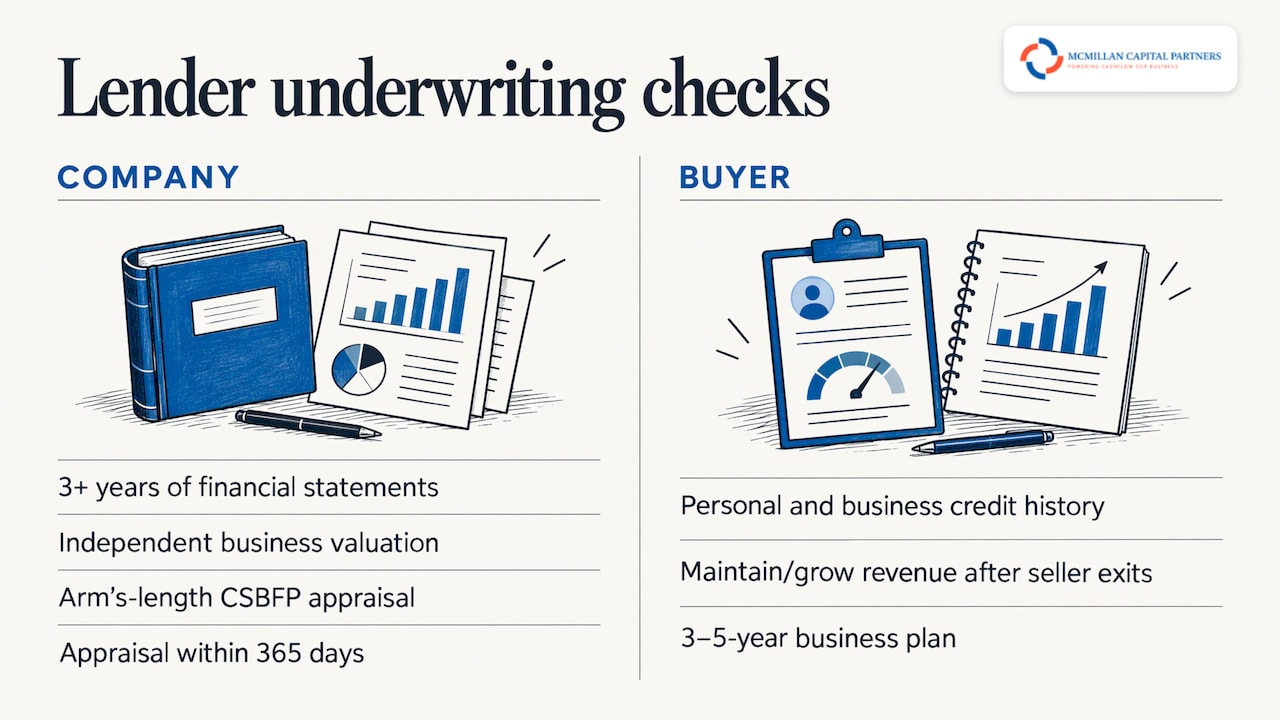
You. The same CFIB page says lenders weigh your personal and business credit history and focus on whether you can maintain and grow revenue once the seller withdraws. A business plan covering three to five years carries real weight.
The principle behind all of this is lender due diligence: statements, credit checks and proof you can repay. This overview of what lenders examine walks through the same logic for commercial borrowing. Under the CSBFP regulations, lenders must apply the same due diligence as for a conventional loan of the same amount, including credit checks on the borrower and anyone legally or financially responsible.
Credit issues and bank declines
Past credit problems are not an automatic stop, but they change who will lend and how the file must read. A lender looking at a bruised credit report wants to see why it happened, what has changed, and why the acquired cash flow covers the payments. We translate a buyer’s circumstances into a lender-ready proposal, which is often the difference between a decline at a standard bank and a yes from a lender whose box fits the deal.
Equity, collateral and personal guarantees
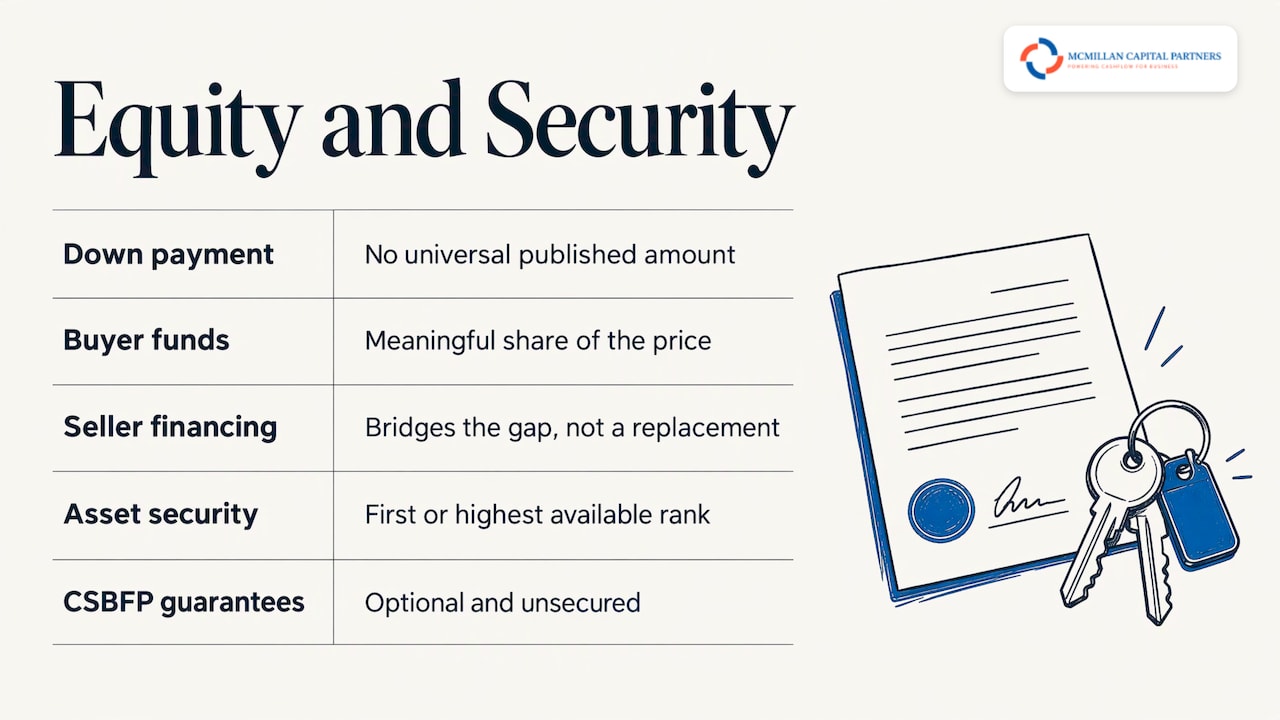
There is no single published down payment that applies to every Canadian deal. What you put in depends on the lender, the assets and the strength of the cash flow. Plan for a meaningful share of the price from your own funds, and treat seller financing as a way to bridge the gap, not replace your stake.
On security, the CSBFP checklist requires a first charge or the highest available rank on assets, with alternate security for items such as software, intangibles, working capital and lines of credit. Personal guarantees under the program are optional, must be unsecured, and, under section 19 of the regulations, cannot exceed the original loan amount (plus judgment interest and legal costs) for loans made after March 31, 2014. Outside the program, the CFIB notes lenders often ask for a personal guarantee even from corporations.
What a purchase loan costs
For CSBFP loans, ISED’s FAQ states these ceilings:
- A 2% registration fee, which can be financed.
- Floating-rate term loans: up to prime plus 3%.
- Fixed-rate term loans: up to the lender’s single-family residential mortgage rate plus 3%.
- Lines of credit: up to prime plus 5%.
- Lender set-up and renewal fees, which cannot be financed.
The prime rate moves with the Bank of Canada’s policy decisions, so check your own quote against the live rate rather than any number printed in an article. Government coverage runs up to 15 years for term loans and five years for lines of credit, a change introduced in the July 2022 amendments, which also raised the limit from $1 million to $1.15 million.
Private and specialist lenders price differently, usually higher in exchange for speed and flexibility. The number that matters is the full cost: rate, fees, security costs, legal and valuation expenses. We show clients the full cost before they commit, so the comparison with a bank offer is made on the whole figure.
Match the structure to the business you’re buying
Different targets call for different lending tools.
- Manufacturers and wholesale distributors: value sits in inventory, equipment and receivables. Asset-based lending lets those assets support the purchase and ongoing working capital. Read more on how asset-based lending works in Canada.
- Transportation and construction companies: the fleet or machinery is the collateral, so equipment financing can carry part of the deal.
- Professional services and tech firms: the value is people, contracts and recurring revenue. Little hard collateral means more weight on cash flow history and your own credit, and a term loan paired with a line of credit for working capital is the common shape. This guide explains loans versus lines of credit.
- Exporters: receivables from foreign customers can be financed as part of the deal, which helps when the acquired book is large.
- First-time owners and young companies: a business under three years old buying a competitor can look at start-up finance.
A step-by-step route to funding
- Fix the structure first. Decide with your accountant whether you are buying assets or shares. It decides which lenders are open to you.
- Collect three years of statements for the target. Add tax returns, a current debt schedule and a list of assets. Our documents checklist covers the typical package.
- Prepare your side. Personal net worth statement, credit report, résumé showing relevant experience, and a three-to-five-year plan.
- Settle the equity and any seller financing. Agree on how much the seller will carry and where that debt ranks behind the lender.
- Get a valuation where required. Some lenders insist on one, and CSBFP asset deals of a going concern need an appraisal.
- Take the deal to the right lender. Banks and credit unions deliver the CSBFP. For deals that don’t fit, we take the file to our curated network of specialist lenders in Canada and abroad.
- Compare total cost, then commit. Rate, fees, security, covenants and prepayment terms all belong in the comparison.
- Close and fund. Lender communication continues through funding, and we handle it for clients.
The timing matters because sellers do not wait. Our typical close is 2 to 4 weeks, and a complete package at the start is the best way to protect it.
Where McMillan fits
We are a commercial finance brokerage in Hamilton, Ontario. Founder Neil McMillan has more than 35 years in commercial finance and built a factoring company from the ground up. Acquisitions that are complex, urgent or outside a bank’s credit box are the deals we are set up for, including specialty and M&A financing. Tell us the target, the structure and where the bank stalled, and we will match the deal to a lender and explain the costs before you commit.

See our specialty finance page for deals that need a tailored structure, or start at McMillan Capital Partners. If you are weighing broader routes, our guide to alternatives to traditional bank loans lays them out.
FAQ
Can I use the CSBFP to buy shares of a company?
No. ISED’s program rules exclude share purchases, and assets acquired by a holding company are also excluded. If the seller wants a share sale, the financing has to come from another source, which is a common reason buyers need a lender outside the standard bank box.
How much can I borrow to buy a business in Canada?
Under the CSBFP the ceiling is $1.15 million per borrower: $1 million in term loans plus a $150,000 line of credit. Outside the program, the amount depends on the target’s cash flow, its assets and your equity. Term loans we arrange run from $50K to $10M+.
Can I get a purchase loan with past credit problems?
It is possible, but the file must explain the history and show that the acquired cash flow supports repayment. Lenders weigh personal and business credit alongside the target’s three years of statements. A broker can present the deal to lenders whose criteria suit your situation.
How long does financing a business purchase take?
It depends on how complete your documents are and how complex the structure is. We typically close in 2 to 4 weeks. Appraisals, valuations and seller negotiations can add time, so start them early.
Sources
- ISED: CSBFP frequently asked questions for small businesses
- ISED: CSBFP loan approval key requirements checklist
- ISED: CSBFP cost-benefit analysis
- ISED: CSBFP Guidelines, April 2024
- Canada Small Business Financing Regulations (SOR/99-141)
- CFIB: Financing your purchase
- Commercial refinance: what lenders want