Construction Equipment Financing in Canada: Options and Costs
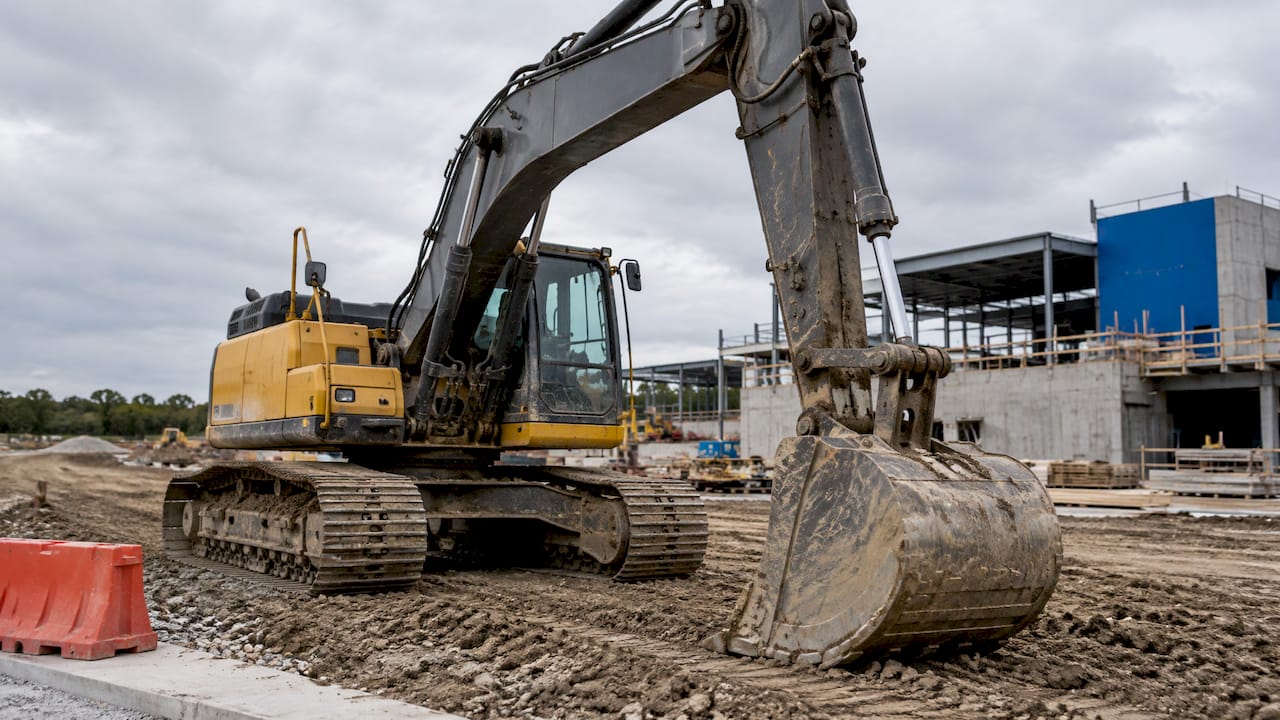
You won the contract, and the excavator, skid steer or paving gear to deliver it costs more than your cash on hand. That is a timing gap, not a sign your business is weak. Construction equipment financing closes it by letting the machine pay for itself while you use it. The harder question is which structure fits your credit, your age as a business and your job pipeline. For Ontario contractors and other Canadian builders, our equipment financing matches each deal to a specialist lender, including deals a bank’s standard credit box won’t take.
- Equipment financing is a loan or lease secured by the machine itself, so the equipment does much of the work of qualifying you.
- A loan builds ownership and usually needs a down payment. A lease can cover close to the full cost and suits gear you will use for a shorter period.
- Lenders mostly turn applicants down over weak sales or cash flow and thin credit history, so a lender-ready file matters as much as the rate.
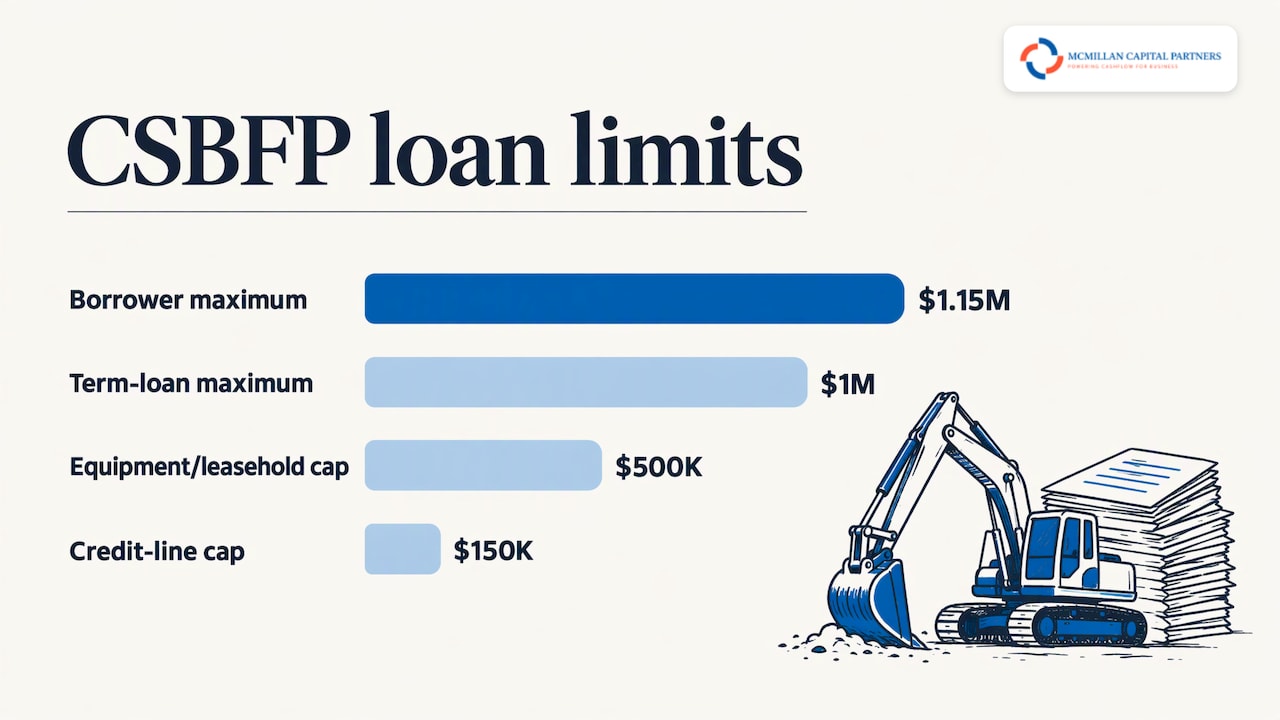
- Federal program loans through banks cap equipment at $500,000. Larger, newer or credit-challenged deals usually need specialist lenders.
- We typically close in 2 to 4 weeks and show you the full cost before you commit.
Table of Contents
- How construction equipment financing works
- Loan or lease: choosing the structure
- What lenders look at
- The government-backed route: CSBFP
- When the bank says no
- What it costs
- A practical sequence for your next machine
- Where we fit
- FAQ
- Sources
How construction equipment financing works
Equipment financing is borrowing to buy or lease a specific machine, with that machine as the main security. If payments stop, the lender can take the asset back. That is why it is easier to get than an unsecured loan: the lender is lending against something it can value and resell.
The usual path looks like this:
- You pick the equipment, new or used, from a dealer, an auction or a private seller.
- The lender assesses the business, the machine and the work it will do.
- The lender pays the seller, and you repay in fixed instalments over a term matched to the machine’s useful life.
- With a loan you own the machine and the lender holds a lien until the balance is paid. With a lease the lender owns it and you pay to use it.
Typical assets include excavators, loaders, dozers, backhoes, cranes, compactors, concrete equipment, dump trucks and trailers. Attachments and some site-ready extras can often be bundled in, depending on the lender.
Loan or lease: choosing the structure
The choice is less about which is cheaper in the abstract and more about how long you will use the machine and what you can do with the tax deduction.
| Equipment loan | Equipment lease | |
|---|---|---|
| Ownership | You own it, lender holds a lien | Lessor owns it, you use it |
| Upfront cash | Often a down payment | Can cover most or all of the cost |
| Best for | Long-life machines you will run for years | Equipment you may swap or upgrade |
| Tax | You claim the depreciation | Lessor claims it; your payments are an expense |
| End of term | Machine is yours | Return, renew or buy out |
The president of a U.S. equipment finance trade association has written that leasing is likely preferable for equipment used 36 months or less, that leases can finance the full cost including transport, installation and training while loans usually need a down payment, and that a business that can’t use depreciation often gets better cash flow by passing it to the lessor. It is a U.S. source, but the logic carries over to Canadian projects: a short, specialized job favours a lease, and a core machine you will run for a decade favours a loan.
Before you choose, ask your accountant how the deduction will land in your return. That answer often decides the structure. If you want to see how leasing is arranged through us, our smart leasing overview explains it.
What lenders look at
Lenders in Canada weigh the same few things whatever the machine. The federal government’s 2019 to 2024 review of the Canada Small Business Financing Program (CSBFP) gives a useful picture of why debt requests fail. The main reasons lenders denied financing were:
- Insufficient sales or cash flow: 34%
- Poor or no credit history: 26%
- Unstable industry: 13%
- Insufficient collateral: 9%
- Project risk: 8%
The same review shows age matters. Businesses two years old or younger had a 78% approval rate in 2022, against 82% for businesses aged 3 to 10 years and 90% for those over 10. Construction had one of the highest debt approval rates of any sector over the nine years reviewed, at 89%.
For your application, that translates into a short list:
- Revenue and cash flow. Recent financial statements, bank statements and your contract backlog. Lenders want to see that signed work can cover the payment.
- Credit. Personal credit of the owners, plus the business’s own payment history with suppliers and lenders.
- The equipment. A quote or invoice, age, hours, serial number. Used machines from private sales need clean title and a fair price.
- Down payment or equity. Some lenders finance up to the full price. Others want a portion in cash.
- Time in business. A younger firm is not shut out, but the file has to carry more of the argument.
The weak point on most files is presentation, not the business. A lender sees a thin year, a late tax filing or a customer concentration and has no explanation. Our job is to translate your circumstances into a lender-ready proposal and handle the lender conversation through funding. For the paperwork side, our step-by-step guide to applying for equipment financing in Canada lists what to gather.
The government-backed route: CSBFP
The Canada Small Business Financing Program lets banks, credit unions and caisses populaires lend to small businesses with the government sharing the risk. The government does not lend directly. Private lenders make the credit decision, and the program pays lenders 85% of eligible losses on defaulted loans, so the program does not guarantee that you will be approved.
Key figures from ISED’s official pages:
- Businesses with gross annual revenues of $10 million or less are eligible, and farming businesses are excluded because they use a separate agricultural program.
- The maximum per borrower is $1.15 million: up to $1,000,000 in term loans, of which no more than $500,000 is for equipment and leasehold improvements, plus up to $150,000 in lines of credit.
- Term loans can buy or improve new or used equipment, including commercial vehicles.
- Since July 4, 2022, the maximum term for non-real-property loans is 15 years, up from 10, and the equipment cap rose from $350,000 to $500,000, according to the same review report.
- The maximum interest rate is the lender’s prime rate plus 3% on floating-rate term loans. A 2% registration fee can be financed within the loan, and a 1.25% annual administration fee can only be charged as part of the interest rate.
A worked example: a $400,000 excavator purchase sits inside the $500,000 equipment cap. The 2% registration fee on that amount is $8,000, which can be rolled into the loan. A new loader at $650,000 does not fit, so you would need another structure for the portion above the cap. Prime moves with the Bank of Canada’s policy decisions, so ask the lender for the floating rate on the day you apply rather than relying on any rate quoted in an article.
For a business with solid financials and a clean credit file, this is a sound route. If your file doesn’t fit, or the machine or fleet exceeds the cap, there are other lenders built for that situation.
When the bank says no
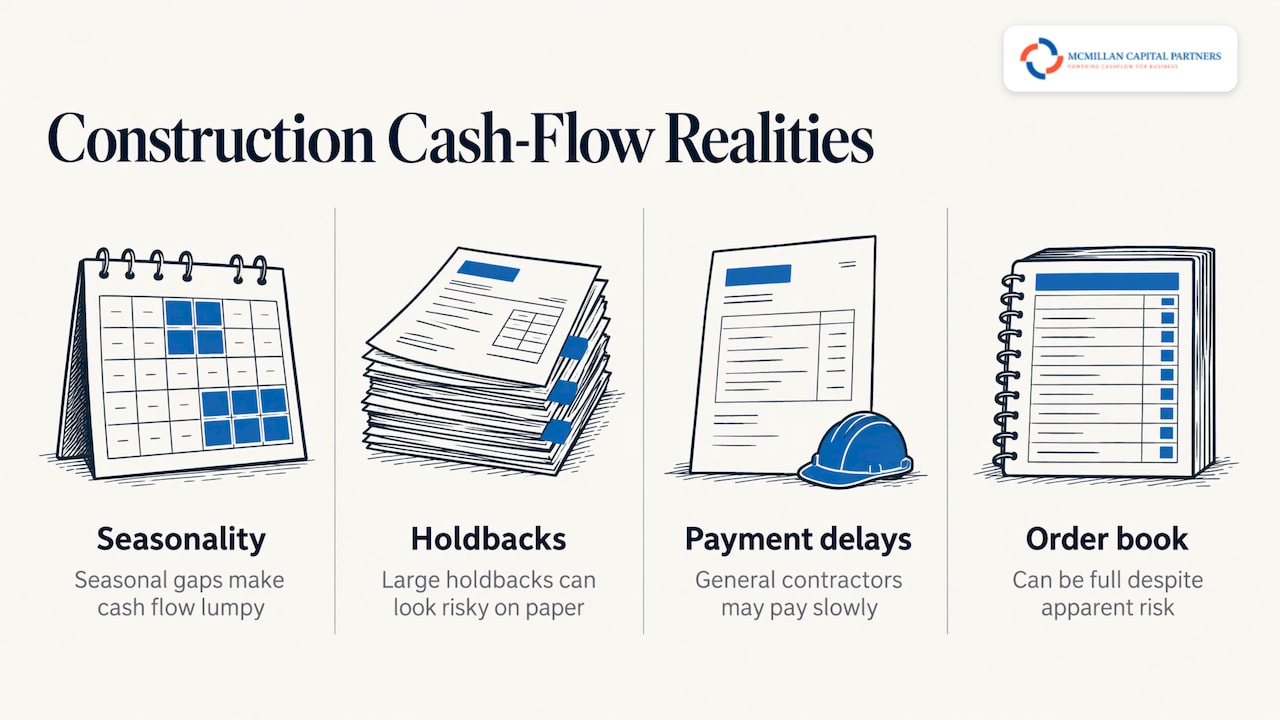
A decline is information about fit, not a verdict on the business. Banks work to a standard credit box: a few years of profit, clean credit, conventional collateral. Construction is lumpy by nature, with seasonal gaps, large holdbacks and slow-paying general contractors. Those patterns can look like risk on paper even when the order book is full.
Specialist lenders assess the same business differently. Some lean on the value and resale market of the equipment. Others look at the contract and the receivables behind it. Which one fits depends on your situation.
Past credit issues
A bruised credit history doesn’t end the conversation, but it changes who you talk to and how the deal is built. Expect a larger down payment, a shorter term or a higher rate than a prime borrower would see. A clear explanation of what happened, and what has changed since, helps the lender price the deal fairly. We show you the full cost before you commit, so you can compare it to the cost of turning down the contract.
Start-ups in their first three years
The CSBFP data shows how important young firms are to this market: in 2019 to 2024, 68% of loan value went to start-ups under one year old. Still, younger businesses face lower approval rates in the same review. Owner experience, the equipment’s value and signed work carry the file. Our start-up finance page and our guide on how start-ups finance first inventory and equipment cover how that works.
Large or mixed needs
Sometimes the machine isn’t the whole problem. You may need the equipment and working capital to staff the job until the first progress payment arrives. In that case equipment financing can be paired with other tools:
- A business line of credit to cover payroll and materials between draws.
- Accounts receivable financing to turn approved invoices into cash instead of waiting 60 or 90 days.
- Asset-based lending when you own enough equipment and receivables to borrow against.
The point is to match each need to the tool built for it. One facility stretched over every need tends to cost more and limit you sooner.
What it costs
The interest rate is one line in the total cost. When you compare offers, look at:
- Rate and term. A longer term lowers the payment and raises total interest.
- Down payment. Cash in versus cash preserved for payroll and materials.
- Fees. Documentation, registration and any administration charges, whether paid upfront or built into the rate.
- Insurance. Lenders typically require the machine to be insured with them named as a loss payee.
- End-of-term terms on a lease: buyout price, return conditions and hour or wear limits.
- Prepayment. Whether you can pay early without a penalty if a big job pays out sooner.
Ask for the payment, total repayment and all fees in one summary, written down. That is how we present it: the full cost laid out before you commit, so a payment that looks light is not hiding a balloon at the end.
To see how this compares to other funding types, our guide to 25 ways to finance a business in Canada and our look at alternatives to traditional bank loans set them side by side. If a term is unfamiliar, the equipment financing glossary defines the main ones.
A practical sequence for your next machine
- Size the job. Work out the contract value, the schedule and when the first payment arrives. That tells you the payment you can carry.
- Decide how long you will use the machine. A few seasons points to a lease. A decade of daily work points to a loan.
- Get the quote. Collect the dealer or seller invoice, with serial number and condition for used units.
- Assemble the file. Financial statements, bank statements, a contract or backlog summary, ID and equipment details.
- Match the lender to the situation. A bankable file can go to a bank program. A non-standard one needs a lender that understands it.
- Compare the full cost. Payment, term, fees, down payment and end-of-term conditions.
- Plan the handoff. Make sure the machine is insured and delivered on time so it is earning when the first payment falls due.
Where we fit
McMillan Capital Partners is a commercial finance brokerage in Hamilton, Ontario. Founder Neil McMillan has more than 35 years in commercial finance and built a factoring company from the ground up. We arrange equipment financing through a curated network of specialist lenders across Canada, the USA, Europe, Australia and New Zealand, and we match each deal to the lender best suited to it. We handle complex, urgent and non-standard deals, and we typically close in 2 to 4 weeks.

If you’re a contractor, manufacturer or fleet operator looking at a machine purchase, start with our equipment financing page. Bring the quote and your recent financials, and we will take the lender conversation from there.
FAQ
Can I finance used construction equipment?
Yes. Many lenders finance used machines, including from auctions and private sellers. Age, hours and condition affect the term and rate. Federal program loans through banks can also be used for new or used equipment.
Do I need a down payment?
It depends on the lender and your file. Loans commonly require one, while leases can cover most or all of the cost, as the trade-association guidance above notes. A weaker credit file usually means a larger down payment.
Can a start-up or a business with past credit problems get equipment financing?
Often, yes, with the right lender. Younger businesses had lower approval rates than established ones in the federal review, so the file needs to show owner experience, the equipment’s value and signed work. Specialist lenders assess these files differently from banks.
How long does approval take?
It varies by lender and how complete your documents are. Through us, deals typically close in 2 to 4 weeks. A full file with a clear equipment quote is the fastest path.
Sources
- Canada Small Business Financing Act Comprehensive Review Report 2019–2024, ISED
- Evaluation of the Canada Small Business Financing Program, ISED
- Canada Small Business Financing Program Guidelines, ISED
- Helping small businesses get loans, ISED
- Find a loan for your small business, ISED
- Lease or Loan? What You Need to Know to Decide