
Spot Factoring in Canada: How Single-Invoice Funding Works

You shipped the order, the invoice is out, and the customer’s payment is 45 or 60 days away. Meanwhile payroll, suppliers and the next job all need cash this month. Spot factoring is built for that gap: you sell one invoice, or a handful, to a funder, receive most of its value right away, and get the balance, less the funder’s charge, once your customer pays. There is no need to put your whole sales ledger under contract.
That makes it a timing tool, not a sign that something is wrong with the business. The question is whether a one-off sale is the right size of tool for your situation. This guide covers how single-invoice factoring works in Canada, what it costs, which invoices and businesses fit, and when to move to a broader facility. We arrange accounts receivable financing for Canadian businesses, including those a bank has declined, so we’ve written it from the borrower’s side of the table.
- Spot factoring (also called single-invoice or one-off factoring) means selling one invoice, or a few, to a funder for an advance now and the remainder when your customer pays.
- BDC notes that a business can factor one or more invoices, one or more clients, or all of its receivables, so a one-off sale is a normal way to use factoring.
- The funder prices the deal on your customer’s credit quality, the invoice amount and your industry, not only on your own credit history.
- Ask for the full cost in writing before you commit: the discount, any fees, the advance rate and what happens if the customer pays late.
- If you find yourself factoring invoice after invoice, a standing facility is usually the cleaner structure.
Table of Contents
- What spot factoring is
- How a single invoice gets turned into cash
- Which invoices and businesses fit
- What spot factoring costs
- What happens to your customer
- Recourse: who bears the risk if the customer doesn’t pay
- Spot factoring, a standing facility or something else?
- Preparing to apply
- How we approach it
- FAQ
- Sources
What spot factoring is
Factoring, as BDC defines it, is the sale of a company’s accounts receivable (the unpaid invoices customers owe you) to a third party. That third party, the factor, collects what is owed and charges you for the service. BDC adds that a business may factor one invoice, several, one customer’s invoices or everything it bills, and may do so for a specific purpose such as meeting payroll.
Spot factoring is the narrow end of that range:
- You choose the invoice. Typically a large one from a creditworthy customer.
- You choose the timing. You use it when a cash crunch hits, not every month.
- The commitment is smaller. Contract factoring covers all or most of your invoices over a set term. Spot factoring covers the invoice in front of you.
The same idea shows up under other names: selective factoring, single-invoice factoring, one-off invoice factoring. They differ in how much each funder packages around them, but the core transaction is the same.
How a single invoice gets turned into cash
BDC’s worked example is a useful template. A company sells a $1 million receivable to a factoring company. The factor pays an advance, may hold back a percentage, deals with the customer to get paid, and then releases the remaining balance to the company minus its discount.
Scaled down to a realistic Canadian job, the flow looks like this:
- Deliver and invoice. A Mississauga manufacturer ships $80,000 of parts on net-60 terms and issues the invoice.
- Submit the invoice. The funder reviews the invoice, the proof of delivery or completed work, and your customer’s ability to pay.
- Receive the advance. The funder pays a percentage of the invoice up front. That percentage is the advance rate, and our guide to what an advance rate is and how it affects invoice finance shows how it changes the cash you see on day one.
- Customer pays. Your customer pays the funder, not you, if the arrangement is set up that way.
- Receive the balance. The funder releases the held-back amount, minus its discount and fees.
The numbers here are for illustration only. Actual advance rates and charges are set deal by deal.
Which invoices and businesses fit
Funders in this space look hardest at the invoice and the customer behind it. BDC says a factoring firm sets its rates after reviewing the credit quality of the company and its customers, the invoice amount and the risk profile of the industry. That is why spot factoring is open to businesses a bank has turned away: your customer’s strength carries weight alongside your own balance sheet.
An invoice tends to be a good candidate when:
- It is for completed work or delivered goods, with no open question about quality or quantity.
- The customer is an established business or a government body with a record of paying.
- The invoice is large enough to justify the paperwork.
- The terms are commercial (net-30 to net-90), not a payment promise that depends on a future milestone you haven’t met.
Who uses it most:
- Manufacturers and wholesale distributors who pay suppliers in 15 to 30 days and collect in 60.
- Transportation and logistics companies carrying fuel, driver and insurance costs ahead of the customer’s payment.
- Construction and contracting firms waiting on large progress invoices. BDC’s advisor notes factoring can help when large payments arrive at project milestones.
- Exporters invoicing foreign customers on long terms.
- Professional services and tech firms with a few large clients and lumpy payment cycles.
- Startups in their first three years with one big customer but a thin credit file.
- Owners with past credit issues, because the customer’s credit is a main part of the decision.
An invoice is a poor candidate when the customer is disputing it, when it has already been pledged to another lender, or when the work isn’t finished. We come back to that last point under security interests below.
What spot factoring costs
The cost of factoring is the difference between what the invoice is worth and what you end up keeping. It has three moving parts:
- The advance rate, meaning how much cash you get up front.
- The discount or factor fee, charged for the time the money is outstanding and the risk taken.
- Any added fees, such as application, due diligence, wire or termination charges.
Because there is no volume to spread the funder’s costs over, a single-invoice deal is usually priced as a one-time transaction. The rate you are quoted depends on the factors BDC lists: credit quality, invoice size and industry. A slow-paying customer costs more than a quick one, because the funder’s money is out longer.
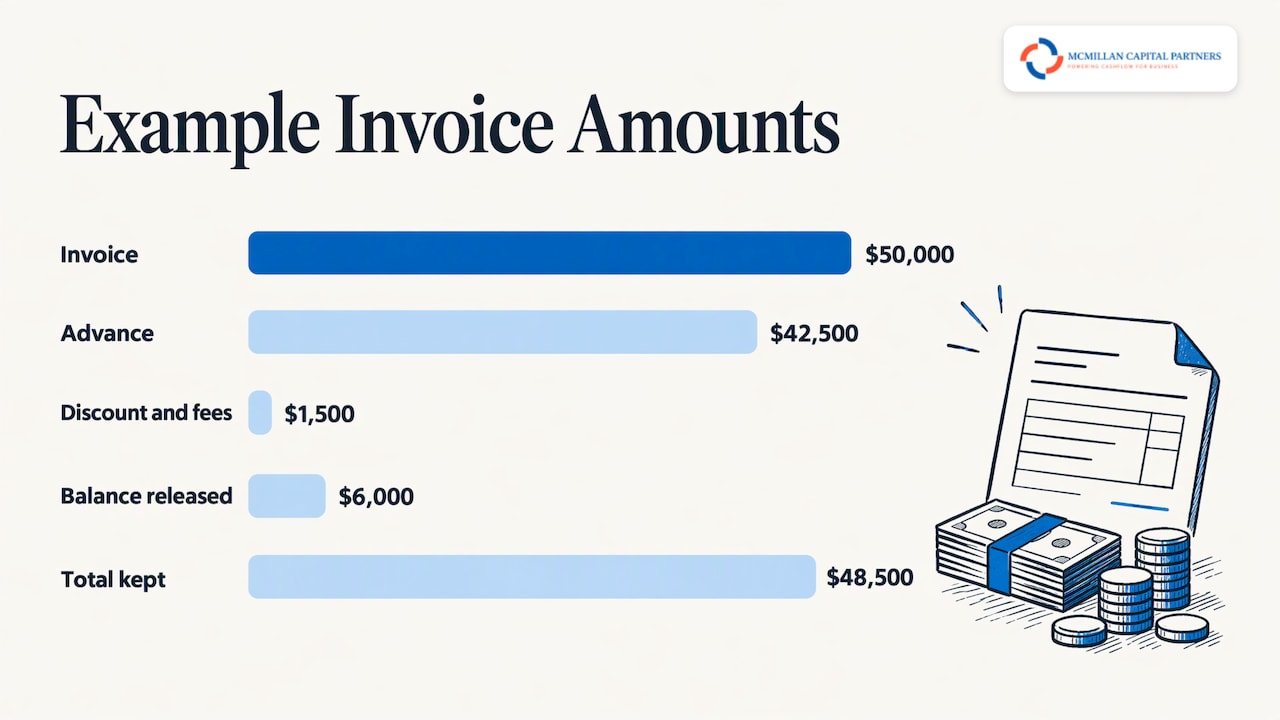
BDC’s advisor Renaud Ponton advises reviewing all fees before signing so you can decide whether there is a business case. Take that literally and run the maths on one invoice:
| Line | Example |
|---|---|
| Invoice | $50,000 |
| Advance at 85% | $42,500 |
| Held back | $7,500 |
| Funder discount and fees (example only) | $1,500 |
| Balance released after customer pays | $6,000 |
| Total you keep | $48,500 |
Now compare that $1,500 to what the invoice lets you do. If the cash lets you accept a $200,000 order you would otherwise decline, the discount is a cost of the order. If it only covers a bill you could have delayed a week, it is not worth it. That is the business case BDC asks you to build.
We show clients the full cost before they commit, so you can put these numbers side by side before any paperwork is signed.
What happens to your customer
Factoring can be arranged with or without notifying your customer. In Ontario, courts have treated a factoring agreement as creating a security interest under the Personal Property Security Act, so the funder normally registers a financing statement against your business claiming an interest in your receivables. The same source notes that an agreement may be on a notification or non-notification basis.
In practice that means three things for you:
- Expect your customer to be told where to pay in many arrangements. Prepare them with a short, matter-of-fact note: you are using a financing partner, the invoice and the terms haven’t changed.
- Keep your customer relationship yours. Orders, service, disputes about quality and pricing still go through you.
- Check existing security first. If a bank already holds a general security agreement over your receivables, the invoice may not be free to sell. Raise this at the start so the funder and your current lender can sort out priority before funding.
Recourse: who bears the risk if the customer doesn’t pay
In a recourse arrangement, you are responsible for buying back or replacing an invoice that the customer does not pay. In non-recourse, the funder takes more of that credit risk, usually at a higher price and with tighter customer criteria. Our guide to recourse invoice factoring walks through how each structure affects your cost and exposure. Settle this before you sign, because it determines what a late or disputed invoice costs you.
Spot factoring, a standing facility or something else?
A one-off sale suits a one-off problem. If the pressure is recurring, a different structure often works better.
| Situation | Usually fits |
|---|---|
| One large invoice, one-time cash crunch | Spot (single-invoice) factoring |
| A few big customers, regular cash gaps | Selective or ongoing accounts receivable finance |
| Receivables plus inventory or equipment to borrow against | Asset-based lending |
| Steady, predictable working capital needs | A business line of credit |
| Buying machinery or vehicles | Equipment financing |
Two cautions in the driver’s seat. First, BDC’s advisor points out that factoring is less common in North America than in Europe, so some customers will ask questions; a clear explanation up front settles most of them. Second, if you factor the same invoices every month, price a standing arrangement against repeated one-off deals. Ongoing facilities spread the funder’s costs across volume. Our piece on when factoring beats a bank line covers that comparison, and working capital alternatives to a bank line of credit lists the other routes.
If the real problem is funding the front end of a big order rather than collecting on a finished one, read how to accept larger contracts without upfront funds. Spot factoring starts after you invoice. Production-stage funding is a different tool.
Preparing to apply
Have these ready and the process moves faster:
- The invoice and the contract or purchase order behind it.
- Proof of delivery or completion, such as a signed bill of lading or sign-off.
- Customer details: legal name, contact, payment history with you.
- An accounts receivable aging report, which lists what each customer owes and how overdue it is.
- A list of existing lenders and security, so priority can be checked early.
- Basic corporate documents and recent financial statements.
Accountants, bookkeepers and fractional CFOs are often the people who produce items 4 to 6. If you advise clients with a cash crunch, a clean aging report and a clear picture of existing security are the two documents that most shorten the process.
How we approach it
We are a commercial finance brokerage in Hamilton, Ontario. Founder Neil McMillan has more than 35 years in commercial finance and built a factoring company from the ground up. We match each deal to the right lender from a curated network of specialist lenders across Canada, the USA, Europe, Australia and New Zealand, turn your circumstances into a lender-ready proposal, explain the costs before you commit and handle lender communication through funding. Deals typically close in two to four weeks.
If you have an invoice, or a run of them, that you need to turn into working capital, start with our accounts receivable finance page.

If a bank has declined you, that is not the end of the conversation. Our approach is built for complex, urgent and non-standard deals, and you can start from the McMillan Capital Partners home page.
FAQ
Is spot factoring the same as single-invoice factoring?
In practice, yes. Spot factoring, single-invoice factoring and one-off invoice factoring all describe selling one invoice, or a few, instead of signing up your whole ledger. BDC notes that a business may factor one or more invoices, so a single-invoice sale is a recognized way to use factoring.
How much does it cost to factor one invoice?
The price depends on your customer’s credit quality, the invoice amount and your industry, as BDC explains. It is usually made up of a discount plus any fees. Ask for the total in dollars on your specific invoice before you commit, and compare it to the value of the order or obligation the cash lets you cover.
Will my customer know I factored the invoice?
It depends on whether the deal is on a notification or non-notification basis, a distinction described by Ontario counsel. Many arrangements ask the customer to pay the funder directly. Agree the approach and prepare a short explanation for your customer in advance.
Can I factor an invoice if my bank already has security over my receivables?
Possibly, but priority must be sorted out first. A factoring agreement creates a security interest under Ontario’s PPSA, so a funder will check what is already registered against your business. Disclose existing lenders at the start so the deal can be structured around them.
Can a business with past credit issues use spot factoring?
Often yes, because funders weigh your customer’s credit and the quality of the invoice alongside your own history. A specialist broker can present your circumstances in a lender-ready way and match the deal to a lender suited to it.