
Working Capital Loan in Canada: Types, Costs and How to Qualify

A working capital loan pays for the day-to-day running of your business: payroll, rent, inventory, supplier invoices. It exists for one problem, timing. Your costs come due before your customers pay. That is a gap, not a sign your business is failing, and the right structure closes it without choking your cash flow. The structure matters more than the label, because “working capital loan” can mean a term loan, a line of credit, financing against your invoices or a facility secured on your assets. At McMillan Capital Partners, we arrange all of these through specialist lenders, including for owners whose bank has said no.
- A working capital loan funds operating costs, not long-lived assets like equipment or buildings. The loan is the tool; the cash-flow gap is the problem.
- In Canada, the government-backed small business financing program caps working capital borrowing at $150,000 per loan or line, with set maximum rates and fees. Larger or less conventional needs go to other structures.
- Match the structure to the gap: a term loan for a predictable, ongoing need, a line of credit for swings, invoice financing when slow-paying customers are the cause, asset-based lending when you hold inventory and receivables.
- Past credit issues, a bank decline, a young business or a non-standard industry do not end the conversation. They change which lender and which structure fit.
- Know the full cost, including fees, before you commit.
Table of Contents
- What a working capital loan actually covers
- The four structures behind the label
- What government-backed working capital financing allows
- Worked example: when the loan size and the structure both matter
- Costs to compare before you sign
- Who qualifies, including after a decline
- What to have ready
- Where we fit
- Choosing the right structure: a quick guide
- FAQ
- Sources
What a working capital loan actually covers
Working capital is the money you need to operate between paying for things and getting paid. The federal government’s small business financing guidelines list what counts as working capital costs: day-to-day operating expenses, including inventory, software and website development, printed materials, professional fees, research and development, payroll and rent.
In practice, owners reach for working capital financing in four situations:
- A big order. You need materials and labour now; the customer pays in 45 or 60 days.
- Seasonal swings. A construction firm in Ontario carries payroll through winter. A distributor builds inventory ahead of its peak.
- Growth. Hiring and stock come before the revenue they produce.
- Slow-paying customers. Your sales are fine. Your receivables are simply late.
It does not cover buying equipment or property. Those assets can usually be financed on their own security, often on better terms, through equipment financing or a dedicated term loan. Keeping the two separate leaves your working capital free for operations.
The four structures behind the label
Search results use “working capital loan,” “operating capital loan,” “working capital financing” and “business loan for working capital” interchangeably. They all describe the purpose. What differs is how the money reaches you and how you repay it.
Term loan
What it is. A lump sum repaid over a fixed period with scheduled payments.
Who it fits. A business with a steady, ongoing need: building a permanent inventory level, funding a hiring plan, absorbing the cost of a new contract. Predictable payments make planning easier.
What it costs. Interest plus any fees, with payments sized to your cash flow. Our business term loans run from $50K to $10M+, depending on the deal and the lender.
Line of credit
What it is. A limit you draw on as needed and repay as cash comes in. You pay interest on what you use.
Who it fits. Businesses with uneven timing: seasonal sales, project work, lumpy collections. It is the natural tool for short-term shortages. See our business line of credit page, or our comparison of a loan versus a line of credit in Canada.
What to know. Many lines are sized against receivables and inventory and are reviewed regularly, so the limit can move with your balance sheet.
Accounts receivable financing (factoring)
What it is. You advance cash against unpaid invoices instead of waiting for customers to pay. Factoring is the form of this where invoices are sold to or financed by a specialist.
Who it fits. B2B companies with creditworthy customers and long payment terms: transportation and logistics, staffing, wholesale distribution, manufacturers selling to large buyers. Approval leans on the quality of your customers’ credit as much as on your own history, which matters if your own credit record is bruised.
What it costs. A fee tied to invoice value and how long the invoice stays outstanding. We lay out the full cost before you commit. Details are on our accounts receivable finance page.
Asset-based lending
What it is. A revolving facility sized on a borrowing base: a percentage of your eligible receivables and inventory.
Who it fits. Manufacturers and distributors with real stock and receivables on the books, and borrowing needs larger than a standard line will support. As your assets grow, so can your availability. Read more on asset-based lending.
What government-backed working capital financing allows
For smaller needs, the Canada Small Business Financing Program is the best-known public framework. The government guarantees part of the loan, which lets participating lenders say yes more often. The rules sit in the Canada Small Business Financing Regulations, and they are specific:
| Feature | Working capital term loan | Working capital line of credit |
|---|---|---|
| Maximum amount for working capital costs | $150,000 | $150,000 |
| Maximum interest rate | Prime + 3% (floating), or lender’s residential mortgage rate + 3% (fixed) | Prime + 5% |
| Registration fee | 2% | 2% |
| Annual administration fee | 1.25% | 1.25% |
| Maximum term | 15 years | 5 years |
Two more points matter before you apply. First, the lender must take security over the business’s assets for these working capital loans, and the regulations also allow an unsecured personal guarantee up to the original loan amount. Second, on a line of credit you attest that it will only pay working capital costs, and that those costs were not incurred more than 365 days before the line was authorized. A line is not a way to refinance old debts.
Eligibility is broad: start-ups or existing businesses with gross annual revenues of $10 million or less, with farming businesses excluded. You apply to your own financial institution, and it makes the approval decision, applying the same due diligence as for any conventional loan, including credit references and ability to repay.
That is the key limit. The program tops out at $150,000 for working capital, and the decision stays with a conventional lender’s credit box. Businesses that need more, need it faster, or have already been through a bank decline usually need a different route.
Worked example: when the loan size and the structure both matter
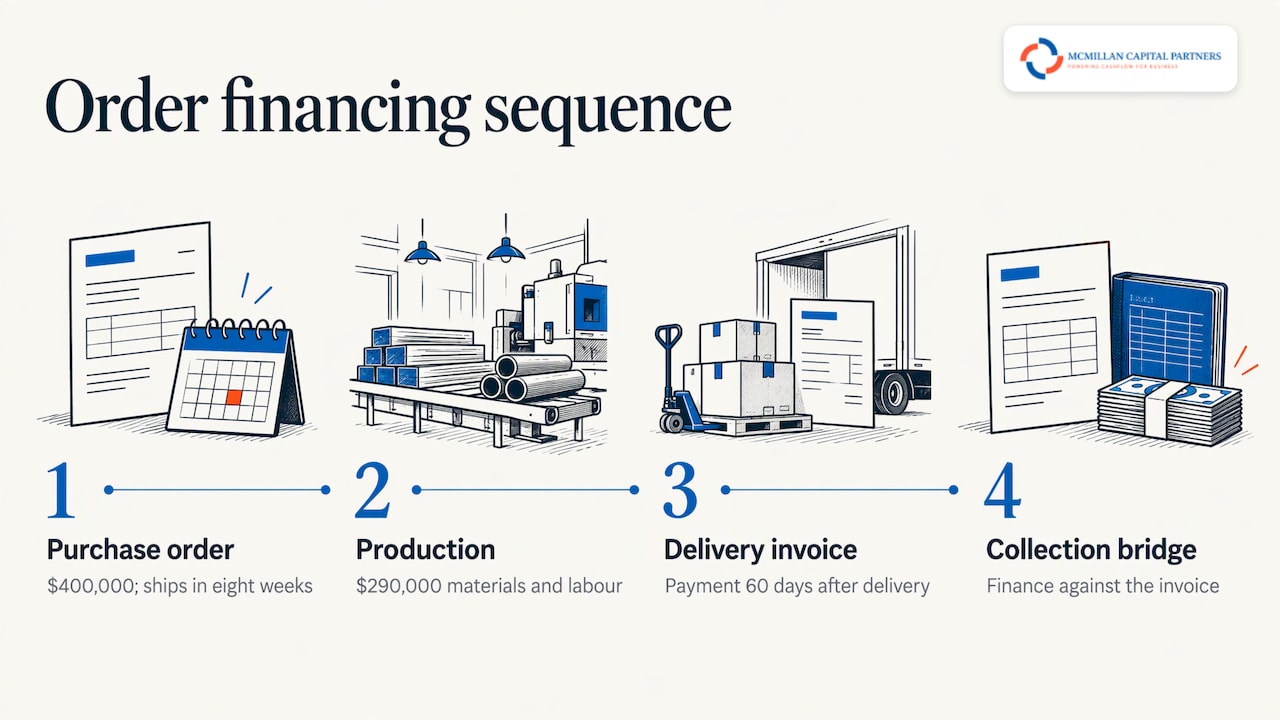
Take an Ontario manufacturer with $2.4 million in annual sales. It lands a purchase order from a national retailer worth $400,000, due to ship in eight weeks, with payment 60 days after delivery. Materials and labour will cost about $290,000 before a dollar comes back.
A $150,000 program loan covers about half. A line sized to the business’s historic sales may not stretch to a one-time spike. Meanwhile the invoice, once issued, is a strong asset: a large, creditworthy buyer who has committed to pay.
A sensible structure splits the problem in two. Production is the front end of the order, funded by a facility sized to the order or to the borrowing base. Collection is the back end, bridged by financing against the invoice. That is the point where a single “working capital loan” stops being the right question and a combination of tools becomes the answer. The figures here are illustrative, not a quote.
Costs to compare before you sign
A headline interest rate rarely tells you what working capital costs. Ask for the total cost over the life of the facility and compare these items:
- Interest or discount rate. Is it fixed or floating, and how is it calculated?
- Upfront fees. Registration, application, legal, document preparation, due diligence.
- Ongoing fees. Annual administration, monthly management or minimum-usage fees.
- Security and guarantees. What assets are pledged, and is a personal guarantee required?
- Repayment terms. Fixed payments, interest-only periods, early repayment conditions.
- Fit. Does the repayment schedule match when your cash actually arrives?
The government program shows how much fees can add up: a 2% registration fee plus a 1.25% annual administration fee on top of the rate. Private and specialty lenders structure costs differently, so the only fair comparison is total dollars paid against total dollars received. We show clients that full cost before they commit.
Who qualifies, including after a decline
Lenders look at the same broad things: how much cash your business generates, your record of repaying debt, your assets, your customers and the strength of the people running it. Where a conventional bank sees a problem, a specialist lender often sees a structure.
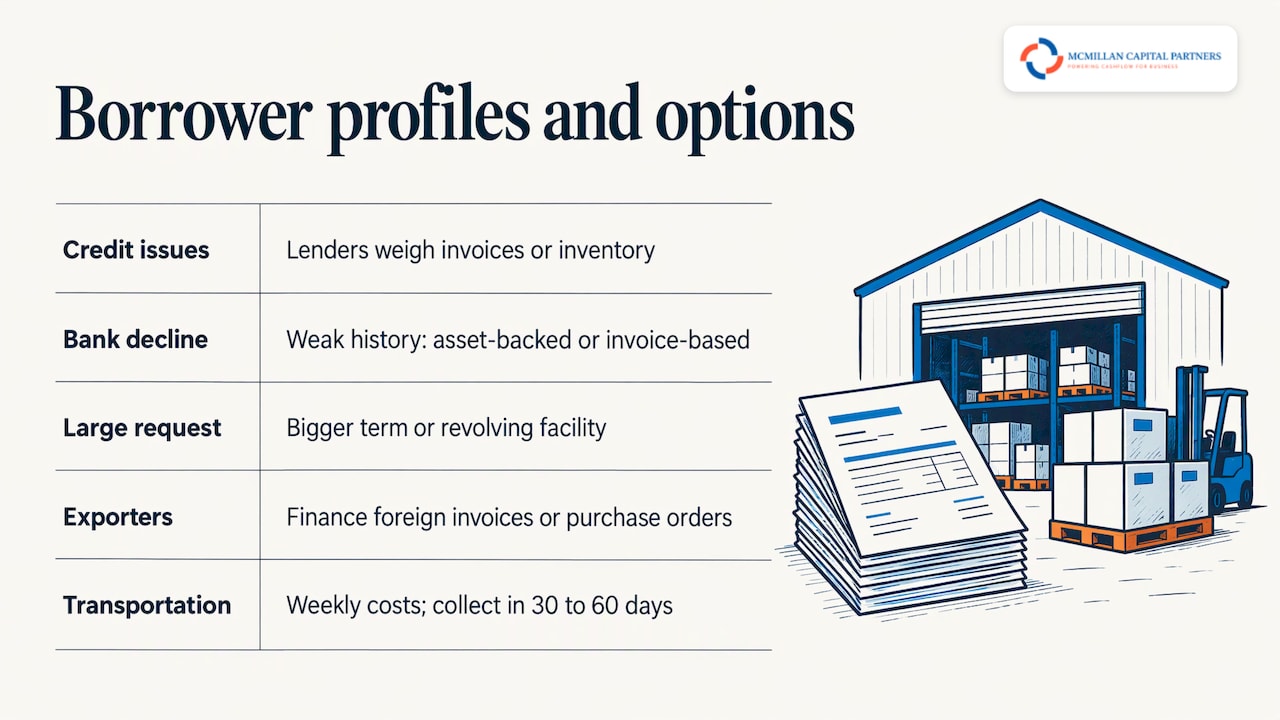
Past credit issues. A late period, a consumer proposal or a prior default makes a bank’s scoring model hesitate. Lenders who finance against invoices or inventory weigh the collateral and your customers heavily. See our guide to qualifying for a working capital loan without diluting equity.
Start-ups in their first three years. Limited history means limited statements. Lenders look at the owners, the contracts in hand and the assets. Our start-up finance page covers what is available.
Declined by your bank. A decline tells you the file did not fit one lender’s box. It does not tell you the business is unfinanceable. The reason for the decline is the most useful clue to the next structure: weak history points toward asset-backed or invoice-based facilities; a request too large for the program points toward a bigger term or revolving facility.
Exporters. Cross-border receivables are a legitimate source of working capital. Financing against foreign invoices or purchase orders is a specialty, and a lender who understands export credit will treat it as an asset rather than a risk flag.
Sector notes. Construction firms often wait on holdbacks and progress draws. Transportation companies pay fuel and drivers weekly but collect in 30 to 60 days. Professional services and tech firms have payroll-heavy cost bases and few physical assets, which narrows traditional options. Wholesale distributors carry stock and receivables, the classic fit for asset-based facilities.
What to have ready
The exact list varies by lender and structure, but a file that is ready moves faster. Most lenders will want:
- Recent business financial statements and year-to-date results
- A current accounts receivable and accounts payable aging report
- Bank statements for the operating account
- A short explanation of what the money is for and how it will be repaid
- Details on the owners and any existing debt
- For order-based needs, the purchase order and customer information
If you are an accountant, bookkeeper or fractional CFO preparing this for a client, the aging reports and a clear repayment story do most of the work. Lenders want to see the gap defined: how large, how long, and where the repayment cash comes from.
Where we fit
A bank offers its own products. We start from your numbers and match them to the lender and structure that fit. McMillan Capital Partners is a commercial finance brokerage in Hamilton, Ontario. Founder Neil McMillan has more than 35 years in commercial finance and built a factoring company from the ground up. We work with a curated network of specialist lenders across Canada, the USA, Europe, Australia and New Zealand, and we handle complex, urgent and non-standard deals.
We translate your circumstances into a lender-ready proposal, explain costs before you commit, and manage lender communication through funding. Closing typically takes 2 to 4 weeks.

If you are weighing a term loan, a line, invoice financing or a combination, start with the business line of credit or accounts receivable finance pages, or contact us with your numbers. For more options beyond the bank, see working capital alternatives to a bank line of credit.
Choosing the right structure: a quick guide
| Your situation | Likely fit |
|---|---|
| Steady, predictable monthly shortfall | Term loan |
| Seasonal or uneven cash timing | Line of credit |
| Slow-paying business customers | Accounts receivable financing |
| Significant inventory and receivables, growing fast | Asset-based lending |
| Large one-off order | Facility sized to the order, plus invoice financing |
| Equipment or property purchase | Equipment financing or dedicated term loan, not working capital |
The single most useful habit is to size the gap before you apply. Add up what you must pay between now and the day customers pay you, subtract the cash you will have, and add a cushion for delays. Borrow against that number, not a round figure.
FAQ
What is the difference between a working capital loan and a line of credit?
A working capital loan is typically a lump sum repaid on a fixed schedule, which suits a predictable, ongoing need. A line of credit is a limit you draw on and repay as cash flows, which suits uneven timing. Many businesses use both, one for the steady base and one for swings.
How much can I borrow through a government-backed program?
Under the Canada Small Business Financing Regulations, working capital borrowing is capped at $150,000, for either a term loan or a line of credit. Larger needs are arranged through other structures, such as term loans from $50K to $10M+ or asset-based facilities.
Can I get working capital financing with bad credit or after a bank decline?
Often yes, with the right structure. Facilities secured by invoices, inventory or other assets weigh the collateral and your customers’ credit alongside your own history. We match each deal to a lender in our network, so a decline from one bank is the start of the search.
How fast can working capital funding arrive?
It depends on the structure and the file. With us, closing typically takes 2 to 4 weeks. Having statements, aging reports and a clear explanation of the need ready is the biggest factor you control.
Sources
- Canada Small Business Financing Regulations (SOR/99-141)
- Canada Small Business Financing Program Guidelines
- Find a loan for your small business, Canada Small Business Financing Program